Clustering
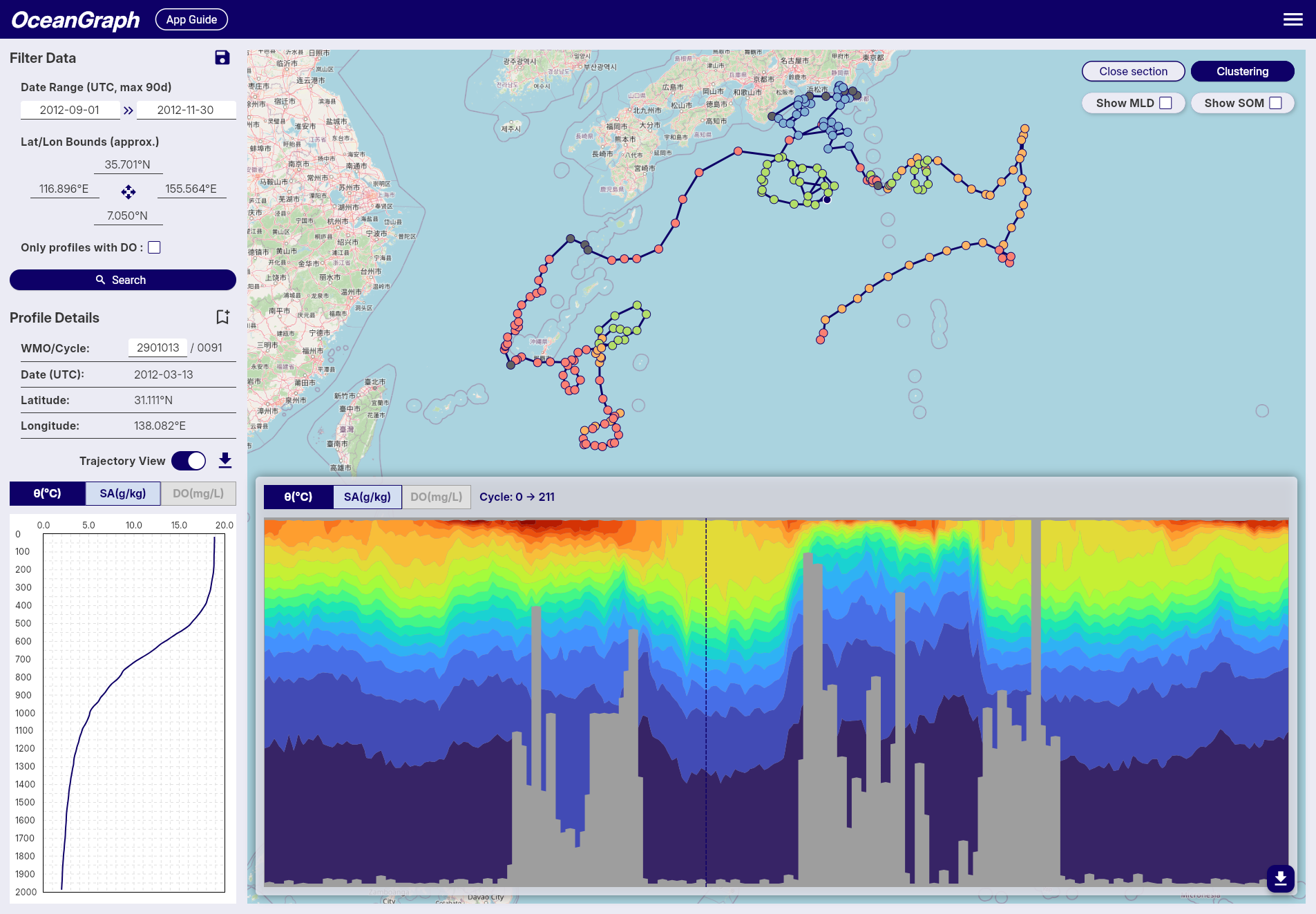
OceanGraph provides an experimental feature that groups Argo profiles by similarities in their vertical structure and location.
Accessing Clustering
Clustering is available to signed-in users only.
- Sign in. Leave Trajectory off to analyze the current search results, or turn it on to analyze the selected WMO trajectory.
- Keep the input at 500 items or fewer: current search-result profiles with Trajectory off, or all cycles for the selected WMO with it on.
- Open Analyze and select Run clustering. On narrower layouts, open Tools first.
- Follow the percentage on Analyze or Tools; the map markers are colored by cluster when processing finishes.
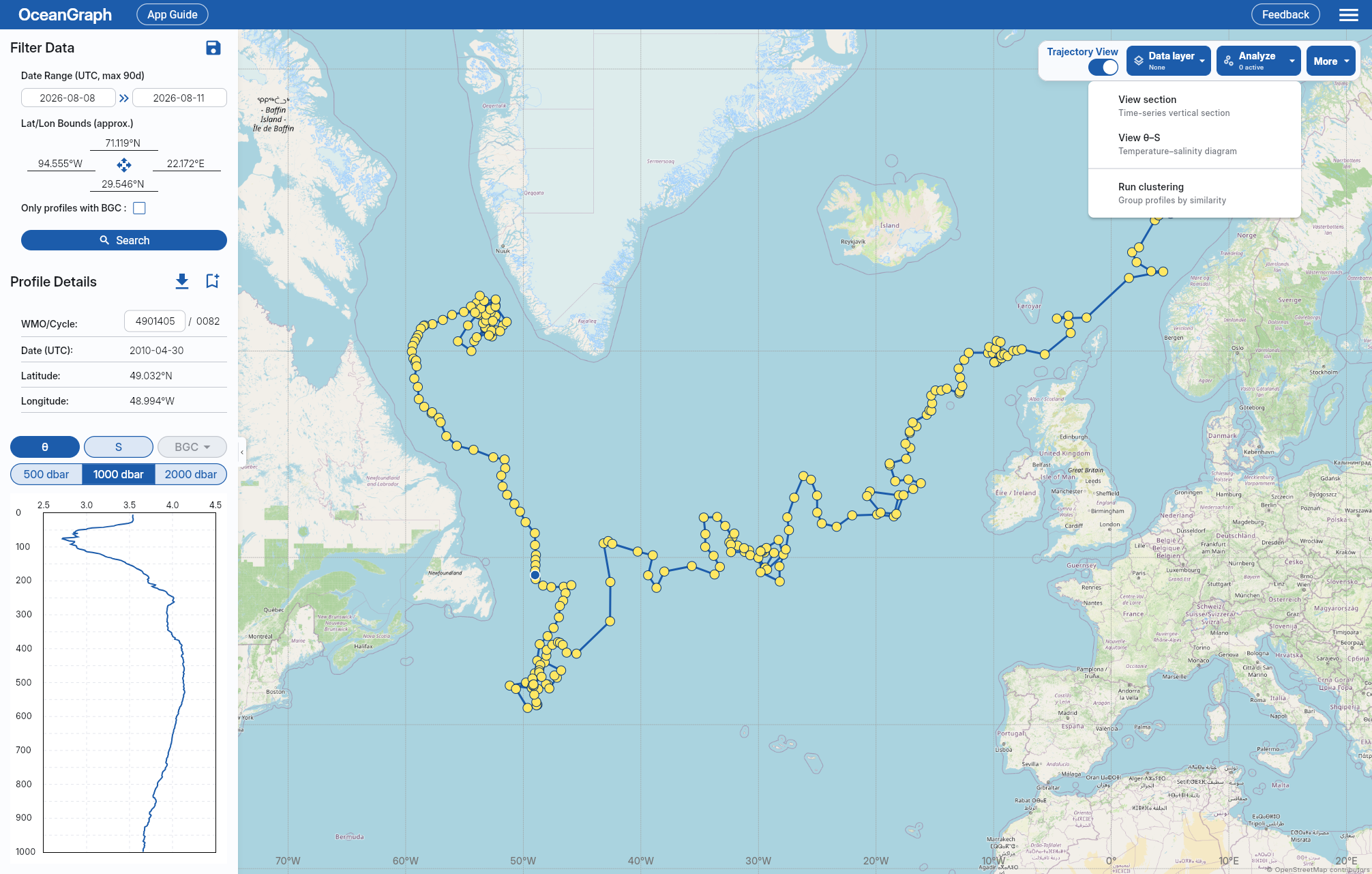
If the input exceeds the limit, the menu item shows the limit and current count and does not start a job. Narrow a Profiles search to recover availability. An oversized trajectory remains unavailable; OceanGraph does not sample, split, or page either input.
While Clustering runs, Analyze or Tools shows progress and provides cancel or retry actions. The map and existing displays remain usable. Only one analysis job (θ–S, Clustering, or 3D view) can run at a time.
Interpreting Results
- Colored markers indicate profiles assigned to clusters.
- Gray markers indicate profiles excluded from clustering because they did not satisfy the required variables or depth coverage.
- The cluster labels are exploratory groups, not confirmed water-mass names.
What the Grouping Uses
- Only pressure rows with a finite temperature-salinity pair are used.
- Profiles are compared on a shared 100 dbar grid from 200 dbar to an upper depth chosen from the input set, with 1000 dbar as the maximum. Profiles that do not cover that range are excluded.
- Temperature and salinity at each depth are standardized and combined with latitude and longitude.
- The number of clusters is selected automatically, up to six. A single eligible profile or identical inputs form one group.
Because the comparison depth and input population depend on the current selection, cluster numbers from different searches are not directly comparable.